One Penny at a Time: Remembering the Berlin Airlift at Arlington National Cemetery
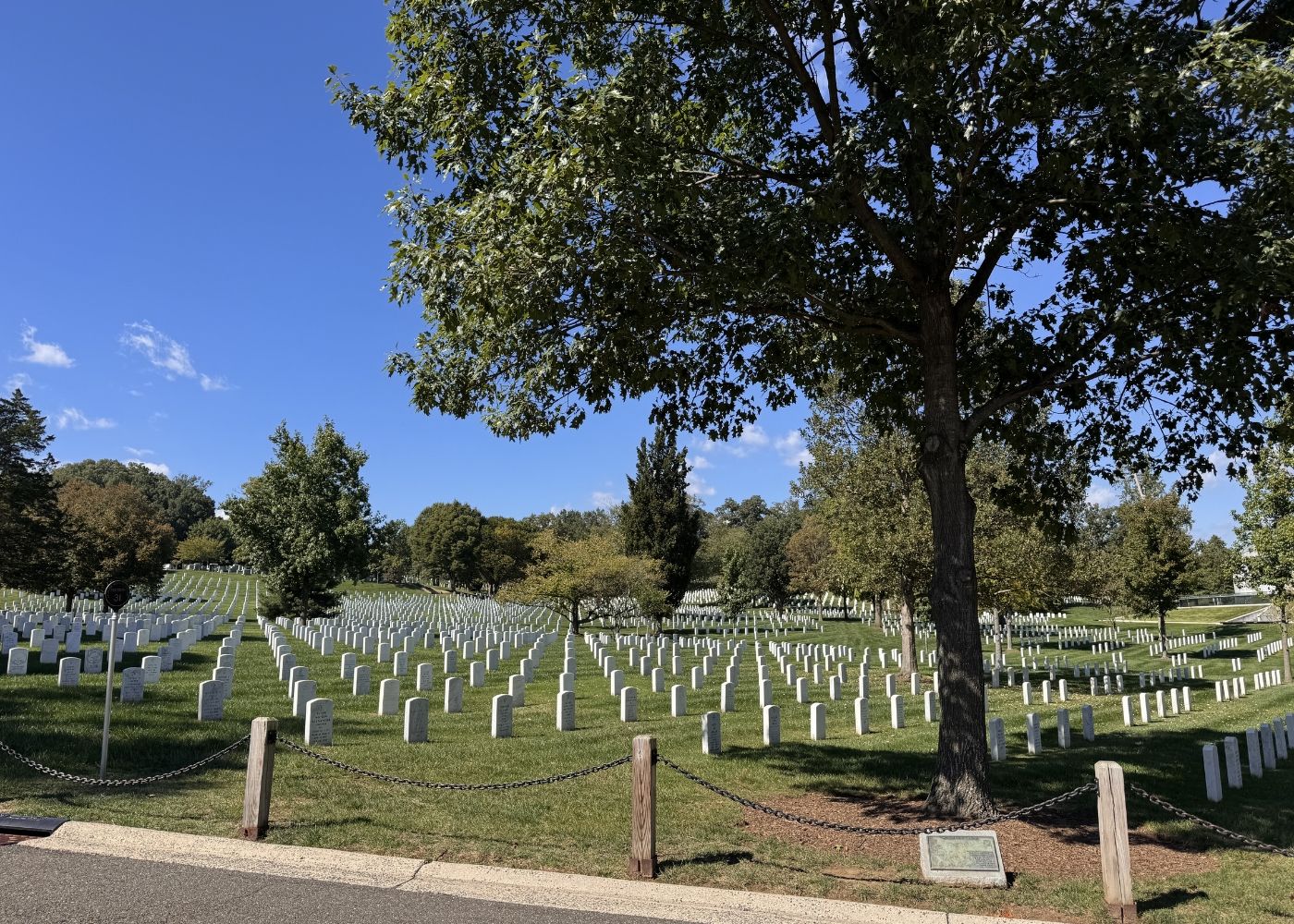
Arlington National Cemetery is an extraordinary place. Spread across 639 acres, it is the final resting place of nearly 430,000 people. Walking among the endless rows of white headstones, I find myself wondering about the lives behind the names.
Who were these people? What did they accomplish? Whose lives did they touch? And what remains of a person after they are gone?
On October 6, 2026, I visited Arlington with Eddie Ide, who shares my passion for preserving the history of the Berlin Airlift. Eddie leads the Berlin Airlift Remembrance Alliance (BARA) and is also working on a book about the Airlift.
We were there as part of the Airlift Penny Project (TAPP), a Wings of Freedom initiative to remember the people who made the Berlin Airlift possible.
We had several graves to visit, a memorial to find, and pennies to leave behind.
Finding six specific graves among nearly 430,000 resting places turned out to be something of an undertaking.
Fortunately, we encountered a cemetery employee who, when we asked for help locating one of the graves, did much more than point us in the right direction. He ended up driving us around in his work golf cart, helping us find several of the graves on our list.
We were certainly grateful for the help. Navigating Arlington can be challenging, even when you know exactly whom you're looking for!
But finding the graves was only part of the reason we had come.
Six Men, Six Different Contributions
One of the things that struck me during this visit was the remarkable variety of roles these six men had played during the Berlin Airlift.
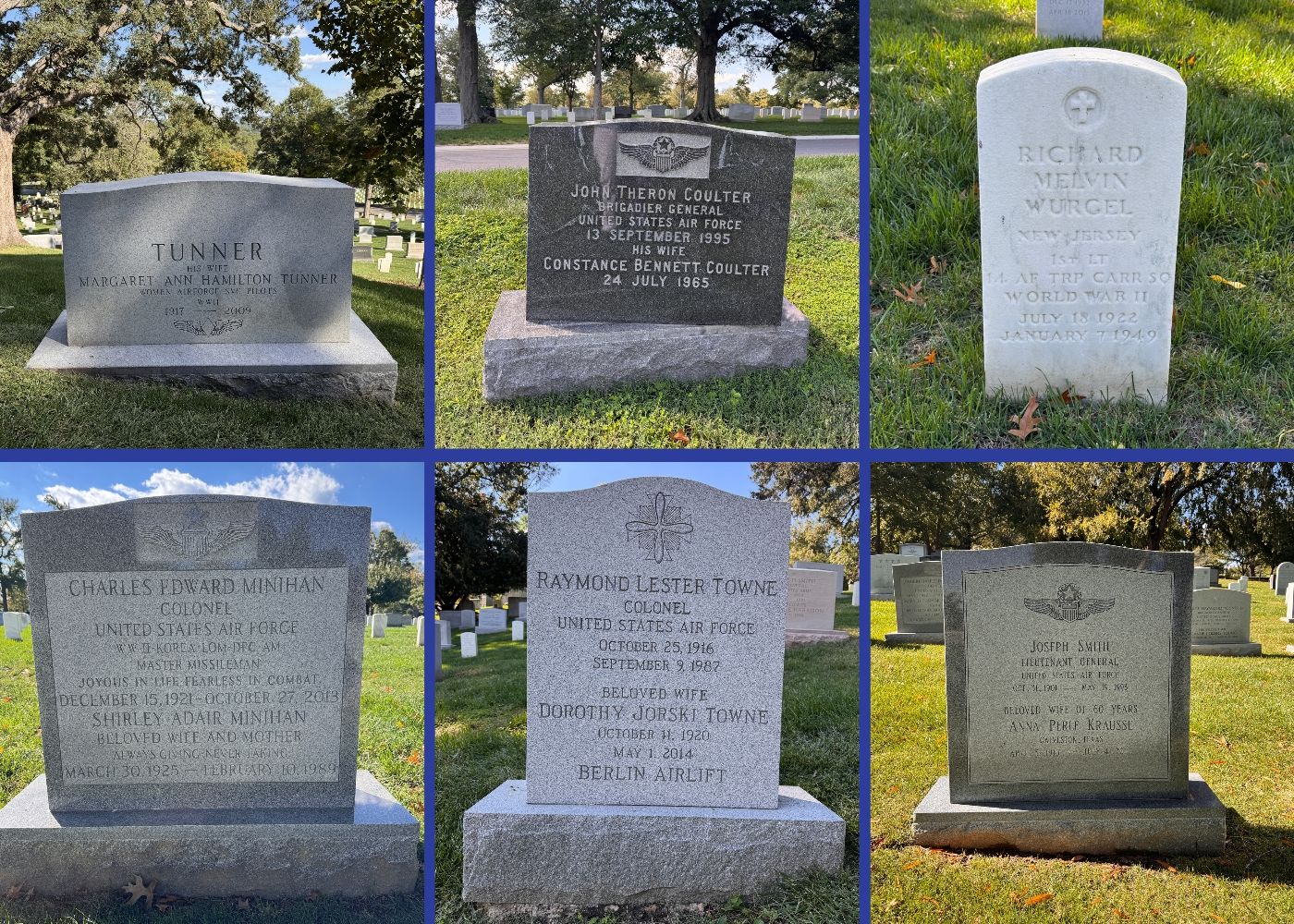
We visited the grave of Lt. Gen. William Henry Tunner, whose name is familiar to anyone who knows the history of the Airlift. He took command of operations in July 1948 and transformed an emergency response into a highly organized, around-the-clock operation.
His leadership, organizational genius, and insistence on efficiency helped accomplish something many had considered impossible: sustaining an entire city by air.
Then there was Brig. Gen. John Theron "Jack" Coulter, who commanded the 60th Troop Carrier Group and later the air base at Fassberg, one of the Airlift's essential departure points for coal flights. His wife, actress Constance Bennett, also became involved in improving the living conditions and morale of the men stationed there.
And 1st Lt. Richard Melvin Wurgel, whose story ended tragically. On January 7, 1949, he and five fellow crew members were killed when their C-54 crashed near Blackpool, England, while transporting aircraft engines and parts to the maintenance facility at Burtonwood. His name is among those honored on the Berlin Airlift Memorial Monument in Berlin, Frankfurt, and Celle.
We also visited Col. Charles Edward Minihan, who helped counter Soviet interference with navigation beacons by securing improved navigation and radar equipment for C-54 aircraft. His contribution helped crews navigate more safely through the narrow air corridors into Berlin.
Col. Raymond Lester Towne Jr. contributed in yet another way. A former World War II B-26 pilot and one of Tunner's trusted staff members, he joined Hal Sims in founding the Task Force Times, which provided operational news and helped maintain morale among Airlift personnel.
And finally, Lt. Gen. Joseph Smith, the Airlift's first task force commander, who made crucial decisions during those uncertain opening weeks in June 1948. He ordered additional aircraft and established early procedures that helped make the enormous expansion of the operation possible.
Six men. Six different stories.
And six very different contributions to the same remarkable undertaking.
Was One Contribution More Important Than Another?
Standing at their graves, I found myself thinking about the different ways we measure a person's contribution.
Certainly, General Tunner's leadership was extraordinary. Without his ability to organize and refine the Airlift, its success might have been very different.
But what about the person who maintained the aircraft? The one who loaded the coal? The technician who solved a navigation problem? The weather forecaster whose information helped a pilot make it safely through the clouds?
How do we measure their contributions?
Some had tremendous responsibilities. Others performed what might be considered relatively small tasks.
But the Berlin Airlift was not accomplished by a handful of famous generals or pilots.
It succeeded because thousands of people, military and civilian, American, British, German, and from other Allied nations, worked together. Each brought something different to the effort. Each depended on the others.
A brilliantly organized flight schedule would have meant little without functioning aircraft, crews to fly them, people to load and unload supplies, and countless others working behind the scenes.
The Airlift was an extraordinary example of what people can accomplish when they work together toward a common purpose.
And that is something I think about whenever I visit the resting place of someone who participated. Whatever their particular role, they were part of something much larger than themselves.
What Remains of a Life?
Walking through a cemetery also makes me think about life itself.
Every headstone represents a person who once had hopes, worries, ambitions, friendships, and family. Someone who made decisions, faced challenges, experienced joys and disappointments, and lived a life far more complex than the few words engraved on a stone.
And then I wonder: What remains?
For the men we visited at Arlington, part of the answer lies in what they helped accomplish during those remarkable months in 1948 and 1949.
They were part of an operation that prevented the Soviet blockade from forcing the Western Allies out of Berlin. Their work helped preserve the freedom of West Berlin at a pivotal moment in German history.
Germany was still emerging from the devastation of World War II. The country was occupied and increasingly divided, and in the western occupation zones, the foundations of a new democratic state were being established. On May 23, 1949, while the Airlift was still underway, the Federal Republic of Germany was founded. Its Basic Law (Grundgesetz) established a constitutional democracy built on fundamental rights, the rule of law, and the dignity of the individual.
The Airlift did not create that democracy. But by successfully resisting the Soviet blockade, it helped protect the freedom of West Berlin and the political conditions in which democracy could take root and develop in West Germany.
The men and women of the Berlin Airlift were not simply supplying a city. They were helping protect the possibility of a democratic future.
The decades that followed would bring further confrontation between East and West. In 1961, the Berlin Wall was built, physically dividing the city and separating families and friends. For another 28 years, it stood as a symbol of the Cold War. Then, on November 9, 1989, the Wall fell. Germany was reunited the following year.
The people who participated in the Berlin Airlift could not have foreseen how the following decades would unfold. Yet their determination helped preserve the possibility of that very future.
As someone who grew up in West Berlin during the Cold War, I find that particularly meaningful.
When I stand at these graves, I often silently thank the people buried there.
Thank you for your service.
Thank you for doing your part.
Thank you for helping make possible the world I grew up in.
It is a quiet, personal moment. And it is one of the reasons I continue making these visits.
Remembering Them, One Penny at a Time
The Airlift Penny Project is built around a simple gesture. Whenever possible, I visit the resting places of people who participated in the Berlin Airlift, learn about their lives and contributions, document their stories, and leave a penny.
Why a penny?
There is a longstanding custom of leaving coins at military graves as a sign of remembrance and respect. Different coins carry different traditional meanings. A penny signifies that someone visited the grave to pay their respects. A nickel traditionally indicates that the visitor trained with the deceased, a dime that they served together, and a quarter that the visitor was present when the service member died.
For the Airlift Penny Project, the penny is particularly fitting. It doesn't imply that I knew or served alongside the person buried there. It simply says that someone came, remembered, and wanted to honor their contribution.
It isn't about the monetary value of what we leave behind.
It is about taking the time to remember.
One penny. One visit. One more story remembered.
A Memorial for All Who Served
During our visit, Eddie and I also found the Berlin Airlift Veterans Association (BAVA) memorial marker at Arlington.
Dedicated on September 29, 1998, the marker honors United States military personnel who served during the Berlin Airlift, from June 26, 1948, through September 30, 1949.
After visiting individual graves, standing before this memorial brought the broader story back into focus. The six men we had visited represented only a tiny fraction of the people who made the Airlift possible. The memorial honors the collective effort. The individual graves allow us to discover the people behind it. Both matter.
Preserving More Than Names
I sometimes wonder what the men we visited would think if they knew that, nearly eight decades after the Berlin Airlift, people were still searching for their graves, researching their contributions, and leaving pennies in their memory.
Perhaps they would be surprised.
Perhaps some would say they were simply doing their jobs.
But what they accomplished was anything but ordinary. The Berlin Airlift demonstrated that people from different backgrounds and nations could unite to defend freedom, help former enemies, and overcome seemingly impossible obstacles without surrendering to force.
That achievement deserves to be remembered.
Not only because it changed the course of history, but because of what it can still teach us.
And perhaps that is part of the answer to the question I ask myself when walking through a cemetery.
What remains of a life?
We leave behind the people we have touched, the choices we have made, the work we have done, and the ways, large or small, in which we have influenced the lives of others.
The men we visited at Arlington left behind something extraordinary.
I am grateful for the part each of them played.
And I am glad we could leave them a penny.
Help Us Remember More Berlin Airlift Participants
Do you know where a Berlin Airlift participant is buried? Perhaps a family member, friend, or someone whose story deserves wider recognition?
The Airlift Penny Project is an ongoing effort to find, document, and honor the resting places of those who participated in this remarkable chapter of history.
We welcome information about Airlift participants, their resting places, and memorials that we may not yet know about.
One penny. One visit. One more story remembered.
