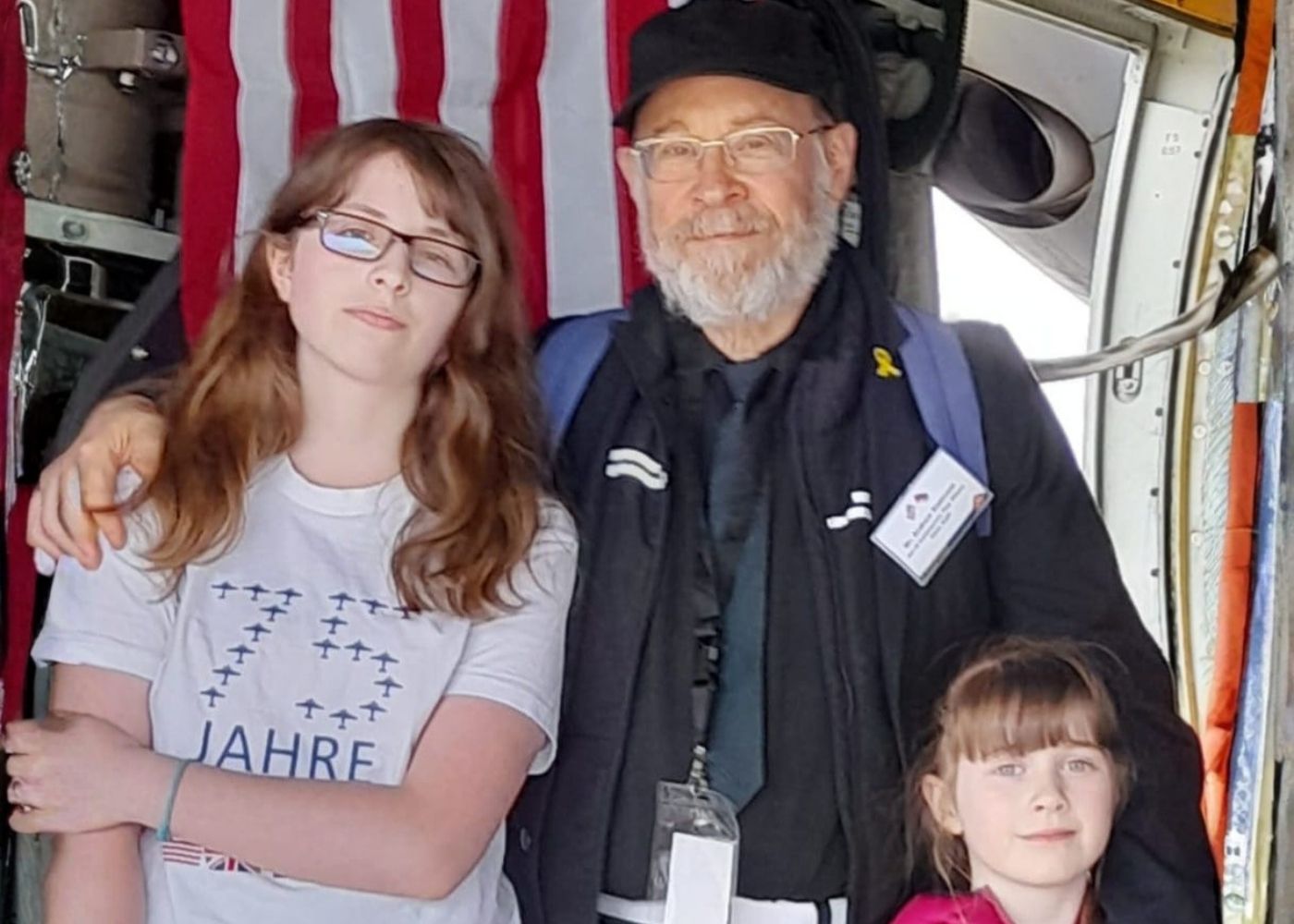
Because She Chose Freedom - Andrew Steiman
How I Met Andy
Our meeting felt like the first sentence of a chapter that had been waiting to be written.
Sometimes, that's exactly how life feels.
I had traveled to the Frankfurt area to interview Berlin Airlift eyewitnesses when another member of what Andrew later called the "Berlin Airlift Family" suggested there was someone I simply had to meet.
That person was Norbert Kandzorra. Norbert knew parts of Andrew's extraordinary family story and was convinced our paths should cross. He arranged for us to meet at the Henry and Emma Budge Foundation in Frankfurt, where Andrew serves as chaplain.
As Andrew showed me around the building before our interview, he pointed out something that perfectly reflected the man he is. Under one roof are rooms for Jewish chaplaincy and Christian chaplaincy. He smiled and remarked how unusual that is.
Looking back now, I realize that our conversation wasn't only about the Berlin Airlift. It was about courage and fear. About silence and memory. About values that are passed from one generation to the next.
And before the afternoon was over, Andy said something that has stayed with me ever since:
“The aircraft carried more than cargo. They carried values.”
By the time we parted that afternoon, I knew I had just heard one of the most remarkable stories of the entire project.

Because She Chose Freedom
Andrew Steiman
My mother lived with fear for almost her entire life. Fear of Stalinism.
As a child, I didn't understand it. In fact, there was so much I didn't know. We never talked about the past in our family. Or perhaps it's more accurate to say that we kept a very loud silence. It wasn't until much later that I finally understood where that fear had come from.
My mother grew up in the Soviet Union in a Jewish family from Ukraine, although during the war they spent part of their lives in Uzbekistan. She had dreamed of becoming a physician and began studying medicine in Tashkent. One of her professors was a German Communist who had fled to the Soviet Union to escape the Nazis. My mother admired her very much.
Then one day, she simply disappeared. My mother asked, "Where is Professor...?" Another student answered quietly, "Don't ask. She's gone. Just don't ask."
That was Stalinism.
Her own family had experienced the same kind of fear. My grandfather knew it was wiser to be careful about what you said and whom you trusted. My mother grew up in a world where people could simply disappear, and where even asking what had happened to them could be dangerous.
Then came the war.
My mother became a nurse with the Red Army. She worked in a field hospital, and as the war progressed, her unit moved steadily westward.
One of the very few stories she ever told me herself took place at the Battle of the Seelow Heights, just outside Berlin in the spring of 1945, where some of the war's fiercest fighting occurred.
She was working alongside a physician who was also Jewish. During those days they learned more and more about what the Germans had done to the Jewish people.
Eventually, their unit moved on, but the medical staff remained behind for a short time. A group of German prisoners of war was still there. Then came the order to execute them. Someone pressed a pistol into my mother's hand and said something to the effect of, "You're Jews. You know what the Germans did to your people."
She was expected to shoot one of the prisoners. She didn't. Years later she told me, "He was about my age. None of this was his fault."
That story has always told me a great deal about who my mother really was. By then she knew what had been done to the Jews. She had seen what human beings were capable of. And yet, when she looked at that young German soldier, the first thing she saw was another human being. She refused to pull the trigger.
In 1948, my mother was still serving with the Red Army as a nurse in Berlin. At that time, people could still move freely between the different sectors of the city. The Wall did not yet exist.
One day she heard about a camp for Displaced Persons in Tempelhof. She wanted to look for someone she knew, so she crossed into the American sector. Then someone told her, "You can't go back tonight."
Why? Because people had seen her in the Western sector. If she returned to her Soviet unit, they would ask questions. Where were you? What were you doing there? Why were you with the Americans? Perhaps they would even accuse her of being a spy.
To this day, I don't know whether my mother had planned to stay in the West when she went to Tempelhof, or whether that decision was made for her once she realized she could no longer safely return. She never told me.
And so, she stayed in Tempelhof. Since she was a trained nurse, people immediately said, "We can use you here." The DP camp was home to people who desperately needed medical care, including survivors of the concentration camps.
Just like that, the life my mother had known was over. She could no longer return to her Soviet unit. She took off her uniform and began working as a nurse in Tempelhof.
Then came one of those remarkable coincidences that almost seem too extraordinary to be true. My mother's birthday was June 25. In 1948, she turned twenty-three. The very next day... June 26... the Berlin Airlift began. I have only a few photographs of her from that time. In them I see a young, twenty-three-year-old nurse.
Years later I learned from others that several American pilots had taken quite a liking to her. Apparently one in particular. How much of it was truly a romance, I'll never know. My mother certainly never discussed those things with her son. And that's perfectly all right. She was my mother. She was entitled to keep a few secrets.
But one story remained. One American pilot wanted to surprise her on her birthday. A real cream cake was almost impossible to find in Berlin in those days. So he flew to Frankfurt... and brought back a fresh cream cake for her birthday. For her twenty-third birthday.
Sometimes I picture that scene. A city lying in ruins. Political tensions growing more dangerous by the day. My mother had just left the Soviet side, fully aware she could never return. No one knew what tomorrow would bring. And then... there stood a young American pilot with a birthday cake. They celebrated her birthday.
The next day, the Berlin Airlift began. Today we know how that story ended. My mother did not. That's something we should never forget.
Today we know the photographs. The airplanes. The statistics. We know the Western Allies stayed in Berlin. We know the Airlift succeeded.
But the people who were living through those days knew none of that. For my mother, the uncertainty wasn't simply historical. It was personal. She had defected. If the Airlift failed... if the Soviets took control of all of Berlin... what would happen to her?
To the Stalinist regime, she was a traitor. And she knew exactly what happened to traitors. That fear stayed with her for the rest of her life.
She continued working as a nurse in the DP camp.
Today, when we think about the Berlin Airlift, we usually picture aircraft bringing coal, food, medicine, and other supplies into Berlin. But, of course, there were return flights as well. The planes weren't meant to fly back empty.
Pregnant women. Small children. Entire families. The sick. The wounded. They were flown out of Berlin. There were also medical evacuation flights.
And here, once again, there is a blank space in my mother's story. I know she accompanied one of those medical transports as a nurse. Exactly how it came about... or which patient she cared for... can no longer be reconstructed. She simply told us too little.
But her journey led from Berlin into Western Germany, and eventually to Bremerhaven, home to America's deep-water port. It was there that the great ocean liners departed for the United States.
She accompanied a patient to the ship as a nurse. She was supposed to help him safely aboard and then leave the ship before it departed. But when the ship left Bremerhaven, my mother was still on board. Was that her plan all along? Or did she simply find herself sailing out of the harbor? I don’t know.
But by then, there was no turning back. And so, my mother sailed to America.
When I look back on her journey today, I sometimes think of it this way: the Berlin Airlift carried my mother out of Berlin. From there, her journey took her across the Atlantic, far away from Stalinism, and into a new life.
Years later I visited the Columbus Quay in Bremerhaven. There's a stone there commemorating the place where Elvis Presley first set foot on German soil. I remember thinking, Elvis Presley is all well and good. But this is where my mother stood on German soil for the last time before boarding that ship. For me, that place has an entirely different meaning.
Yet even in America, she was never truly free from fear. At the time, agreements still existed under which Soviet citizens could be repatriated to the Soviet Union. My mother knew exactly what awaited people who were branded traitors.
Among the displaced people arriving in America, word had spread: if you wanted to stay, it was safer not to say you were Russian.
My mother spoke Polish. Her family came from Ukraine, and Ukrainian was spoken at home. So, her real story became a different one. Her American papers later listed her birthplace simply as Poland. It remained that way for the rest of her life.
She was even afraid my brother or I might innocently tell someone at school, "My mother was part of the Berlin Airlift!" To her, that was dangerous.
She never told us these stories when we were children. Only fragments. Brief glimpses. A sentence here. A memory there. Years later, we had to piece the story together ourselves.
At one point I said to her, "Mom, you're a hero." Her answer was so typical of her. "I'd rather be a quiet mother than a dead hero." That ended the conversation.
I tried to reassure her. "Mom, you're living in America now. You're an American citizen. Your sons are Americans. No one is going to send you back." She simply replied, "You don't understand. I'm afraid."
And that fear ran deep. She had watched people disappear. Her family had lived under Stalin's secret police. She had served in the Red Army... and then defected.
That generation carried an enormous burden throughout their lives. One day my mother finally said, "After I'm gone, it won't matter what you tell people about me."
Now she's gone. Now I can tell her story.
Eventually, she found her place in America. After several stops along the way, she settled in New York, where she met my father. In time, my brother and I were born. That's why I can say, quite literally: Without the Berlin Airlift, I wouldn't exist.
That's not simply a nice phrase I've invented for a speech. It's a fact. If my mother had never gone to Tempelhof... if she had not stayed there... if the Airlift had never happened... and if she had not made that extraordinary journey to America... she never would have met my father in New York. I would never have been born. I am the result of that story.
Perhaps that's why I eventually came to understand something important: All of us are part of world history. Most of us simply don't realize it while it's happening.
My mother had no idea in 1948 that the day after her 23rd birthday would one day appear in history books. She was simply living her life. Making decisions. And those decisions continue to shape lives today.
Mine.
And now... the lives of my children. My children never knew their grandmother. She died before they were born. Naturally, they've asked me, "Who was Grandma?" They want to hear these stories. Perhaps that's one of the reasons I talk about them so much today.
Because my mother couldn't.
I grew up in New York. Later, our family returned to Germany. To be honest, that wasn't entirely my choice. Our apartment in New York was given up. I didn't even get the chance to go back and properly say goodbye to my bedroom. Suddenly, I was told, "We're staying here now." That was hard for me.
In 1970, I started attending a German high school. There was, however, one unexpected advantage. The teacher introduced me to the class as the new boy from New York. Suddenly, the girls found me interesting.
Well... you have to appreciate the positive side of world history too.
I graduated from high school in Germany and eventually returned to the United States. There I discovered something rather important. College costs money. A lot of money. So I did whatever work I could find. I waited tables. I drove a taxi. Eventually, I found work as a translator.
That job brought me back to Germany once again. For fourteen years I worked as a translator for the U.S. Army at the former IG Farben Building in Frankfurt, then known as the Abrams Complex.
During those years, I also volunteered as a chaplain with the military. It was there that I met many remarkable people. One of them was General Colin Powell.
At the time, he commanded V Corps in Frankfurt. I'll never forget our first meeting. One lunchtime I stepped into the paternoster elevator with a bagel in my hand. Suddenly I noticed a shadow behind me. When I turned around, there stood General Powell. He stepped into the elevator beside me. I instinctively snapped to attention... and saluted. With the bagel still in my hand.
He looked at it, broke into a broad grin, and exclaimed, "A bagel! I love bagels!"
So, I held it out to him. As the elevator slowly carried us upward, he studied it for a moment, finally took it from my hand, bit into it, closed his eyes briefly with obvious satisfaction, smiled, handed the half-eaten bagel back to me... and calmly stepped out of the elevator, still chewing.
That's how our friendship began.
From then on, General Powell stopped by the translators' office regularly. Almost every time, he brought along a fresh bagel for us to share. We talked about politics. About our shared hometown of New York. About history. And sometimes about the building in which we worked.
For me, the former IG Farben Building was a place filled with contradictions. In the very building where plans had once been drawn for Auschwitz-Monowitz, Americans and Germans were now working side by side.
General Powell cared about people, not just their work. Eventually he also visited the Jewish Chapel where I volunteered. During the High Holy Days, he simply put on a kippah and quietly took a seat in the back. A few soldiers stood as he entered, out of respect for his rank. Softly, he motioned for them to sit back down. "When we pray," he said, "we stand only before God." I've never forgotten those words.
One day after a service, he pulled me aside. He complimented me on my sermon and then asked me a question completely out of the blue. "Why don't you become a rabbi? There are plenty of translators. As a rabbi, you could help make the world a little better."
At the time, I had no idea just how those words would change the course of my life.
A few years later... the translator became a rabbi. As a rabbi and teacher, my path eventually led me back to Berlin. I taught at the Jewish High School there.
One day, my mother came to visit. Naturally, I wanted to take her to Tempelhof. "Mom," I said, "come on. Let's go."
"No, no," she answered. "Please don't."
I found that surprising. She wanted to stroll along the Kurfürstendamm. She wanted to revisit places from her past. But Tempelhof? No.
Later I asked again. Once more she said, "There's no need."
She never returned to Tempelhof. Perhaps it was all simply too much. The memory of realizing she could never go back. The fear. The young American pilot. The birthday cake. Perhaps all of it together. I don't know.
And over the years I've come to realize... I don't have to know. She was my mother. She's allowed to keep a few secrets.
But one thing is perfectly clear to me. This isn't only her story. It's also mine.
Many years later, I found myself standing at the Berlin Airlift Memorial at Frankfurt Airport.
During the ceremony marking the seventieth anniversary of the Airlift, I had been invited, together with an American Air Force chaplain from Ramstein and the airport chaplain, to lead an interfaith service.
As we prepared for the ceremony, we were told that we should remember those who were no longer with us. And I was asked to begin with my mother's story.
There I stood... decades later... at the Berlin Airlift Memorial... telling the story of a young Jewish nurse who, in 1948, had no idea where life would take her. My mother. It was an incredibly moving moment.
Through encounters like these, I gradually became part of what we sometimes call the "Berlin Airlift Family." I love that expression. Because what really makes a family? Not simply blood. Sometimes it's something else. Shared experiences. Shared memories. Shared values.
For me, that's the very heart of the Berlin Airlift. After all, what remains of a great historical achievement if we forget the people behind it?
We spend a great deal of time talking about numbers. How many airplanes? How many tons of coal? How many takeoffs and landings? How many sacks of flour?
All of those matters. But if that's all we talk about, we lose the real story.
History is often taught through facts and reason alone. That isn't enough. We also need an emotional bridge.
The Berlin Airlift was both.
A bridge of logistics and a bridge of the human heart. The aircraft carried more than cargo.
They carried values.
Freedom.
Humanity.
Responsibility.
Solidarity.
And the willingness to help someone who, only a few years earlier, was your enemy.
Isn't that one of the most extraordinary stories imaginable?
Enemies became friends.
People who had fought one another only a few years before suddenly found themselves working side by side to keep Berlin alive.
Perhaps this is the teacher in me speaking. But that's exactly why these stories have to be passed on. Not because we should become nostalgic. But because values survive only when the next generation understands that people before them made choices to defend those values.
My daughter once wore a T-shirt commemorating the seventy-fifth anniversary of the Berlin Airlift to school. The other students asked her what it was. They had never even heard of the Berlin Airlift.
And I remember thinking, How can that be? How can a story survive if young people no longer know it ever happened? We have to change that!
That's why I don't believe we should simply present history to young people as another school lesson. We have to help them see that it has something to do with their own lives.
I've often put it this way: Young people need to understand: I am part of world history. I am the result of world history.
For me, that's literally true.
My daughter never knew her grandmother. But I can tell her, "Your grandmother was there. She stood in Berlin. She made a decision. And because she made that decision, I exist... and so do you."
Suddenly, the Berlin Airlift is no longer just another chapter in a history textbook. It becomes family history. And that's exactly what we need. We have to tell the stories.
Of the pilots.
The mechanics.
The Berliners.
The children.
The nurses.
The men who unloaded coal.
Those whose names are engraved on memorials.
And those whose names no one remembers.
Because one day, the eyewitnesses will all be gone. Then the stories will remain. And if we don't continue telling them, the values they carry will disappear with them.
You can set up a booth at an event like the Hessentag and reach two hundred or maybe four hundred people. That's wonderful. But I believe a great film could reach millions.
Not simply as a documentary about airplanes.
But as a story about people.
About choices.
About fear.
About courage.
About freedom.
About the possibility that enemies can become friends.
And about what we choose to do with that legacy today.
